People often talk about emotional regulation as if the regulated person is always calm, patient, and pleasant. That picture is too narrow.
A person can look calm while shutting down. Another can cry, speak firmly, or ask for space and still be regulating well. The visible intensity of an emotion does not tell us everything about the quality of the response.
Emotional regulation is the ability to notice what is happening inside you, understand enough of the situation, and choose an action that does not create unnecessary harm. Calm can help, but it is not the only acceptable outcome.
Emotions are signals, not commands
An emotion gives information. Anger may point to a boundary, unfairness, fear, exhaustion, or an unmet expectation. Anxiety may signal danger, uncertainty, lack of preparation, or a nervous system that has been under strain for too long. Sadness may ask for rest, support, meaning, or time.
The signal deserves attention. It does not have to control the next move.
I can feel angry and decide not to send the message yet. I can feel anxious and still attend the meeting after preparing properly. I can feel hurt and ask a direct question instead of building a complete story about the other person’s motives.
Regulation creates a small space between the signal and the action.
Suppression can look like control
Many adults were praised for being easy, quiet, or strong. They learned to contain emotion so well that other people rarely felt uncomfortable around them. That may have been useful in certain environments. It can also make it difficult to recognize needs before they become urgent.
Suppression often focuses on appearance. Do not cry. Do not raise your voice. Do not let anyone see that you are affected.
Regulation focuses on function. What am I feeling? What triggered it? What does my body need? What action fits my values and the situation?
The regulated response may still include visible emotion. It simply has more choice in it.
Start with the body
Strong emotions are not only thoughts. They appear through muscle tension, breathing, heart rate, temperature, restlessness, heaviness, nausea, or a sudden urge to leave.
It is difficult to reason clearly when the body believes it is under threat. Simple physical support can make the next decision easier. Slow the exhale. Place both feet on the floor. Drink water. Move to a quieter space. Release your jaw. Walk before continuing the discussion.
Aroma can also become part of a personal regulation practice when it is safe and associated with a helpful routine. The scent is not doing all the work. It can serve as a cue to pause, breathe, and return attention to the present.
Name the situation accurately
A vague feeling often becomes more manageable when the situation is described clearly.
Instead of saying, “Everything is too much,” I can identify that I have three deadlines, a child needs help with schoolwork, and I have not eaten. That description gives me possible actions. I can move a deadline, ask someone to take ownership of one task, and eat before deciding anything else.
Accuracy reduces the size of the problem. It also prevents one difficult moment from becoming a judgment about your whole life.
Choose the next useful action
Regulation does not require solving everything immediately. Often, the task is to choose the next useful action.
That may be delaying a response, asking for clarification, setting a limit, apologizing, resting, eating, writing the facts down, or ending a conversation that is no longer productive.
The action should fit the emotion, the relationship, and the consequences. A technique that helps in one situation may be avoidance in another. Taking space can be wise during a heated argument. Taking space for three weeks without explanation may damage trust.
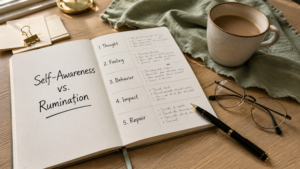
Strong emotions can also trigger repeated analysis. Self-Awareness or Rumination? explains how to recognize the point when reflection has stopped helping.
Emotional regulation grows through practice, not perfection. You notice a little sooner. You recover with less damage. You repair when needed. You learn which supports actually work for you.
The goal is not to become emotionally flat. It is to remain connected to yourself while making choices you can stand behind.
Need practical support for emotional patterns?
My coaching and workshops use psychology, mindfulness, and aromatherapy to help people work with stress and emotional patterns in everyday life. Explore my services and start with a Project Fit Call.